
Written by Dr Elaine O’Connor-Haq, MB BCh BAO, MPharm, L7Dip(Aes)
Medical Aesthetics Doctor and founder of Bespoke Medical Aesthetics, Colchester
Collagen banking, the idea of proactively preserving and stimulating your skin’s collagen before visible signs of ageing emerge has become a major talking point in aesthetic medicine. But how much of it is backed by science, and how much is marketing hype? As an aesthetics doctor, based in Colchester, I believe in leveraging the concept thoughtfully: encouraging prevention, realistic expectations, and combining evidence‑based strategies with in‑clinic treatments. In this post, I’ll unpack what collagen banking really is, where the science is strong, where it is less clear, and how you can build a practical, medically‑led plan for maintaining skin structure over the long term.

What Is Collagen Banking?
“Collagen banking” does not mean you deposit collagen like money in a financial account. Rather, it’s a proactive framework to sustain or boost collagen production before significant loss occurs, so your skin starts from a stronger baseline as you age. Tactics include lifestyle changes (diet, quality sleep, sun protection), home skincare, and in‑clinic interventions (microneedling, biostimulators, skinboosters, and energy-based devices).
As described in beauty media, this concept aligns with the physiological reality that collagen production declines over time. A number of popular articles, such as this collagen banking overview in mainstream media, highlight claims of ‘plumper, youthful skin.’ While the trend is real, evidence shows that outcomes depend on many factors, including age, genetics, and lifestyle.
Why Does Collagen Declines?
To understand why the concept of banking collagen arose, it is important to understand why and how we lose collagen as we age. Below, I detail five main factors that contribute to the decline of our natural collagen production:

1. Your Skin Makes Less Collagen Over Time
Dermal fibroblast cells (the cells that produce collagen, elastin, and hyaluronic acid) produce less collagen as we age. In aged human skin, reductions in type I and III pro-collagen synthesis have been documented.
“With fewer “building blocks” being made, skin gradually becomes thinner, less elastic, and slower to repair itself.“
In addition to this, mechanical stimuli (tension, stretch) which help drive collagen production are also less efficient in older skin. (Varani et al, 2006) With fewer “building blocks” being made, skin gradually becomes thinner, less elastic, and slower to repair itself.
2. Collagen Fibres Become Weaker and Looser
With age, collagen density in the skins dermis decreases leading to significantly less collagen filling and supporting the skin resulting in deeper skin layers gradually becoming thinner and weaker. One review notes that collagen density declines by approximately 1% per year in adult skin. (Park, 2023)
3. Environmental Damage Speeds Up Collagen Loss
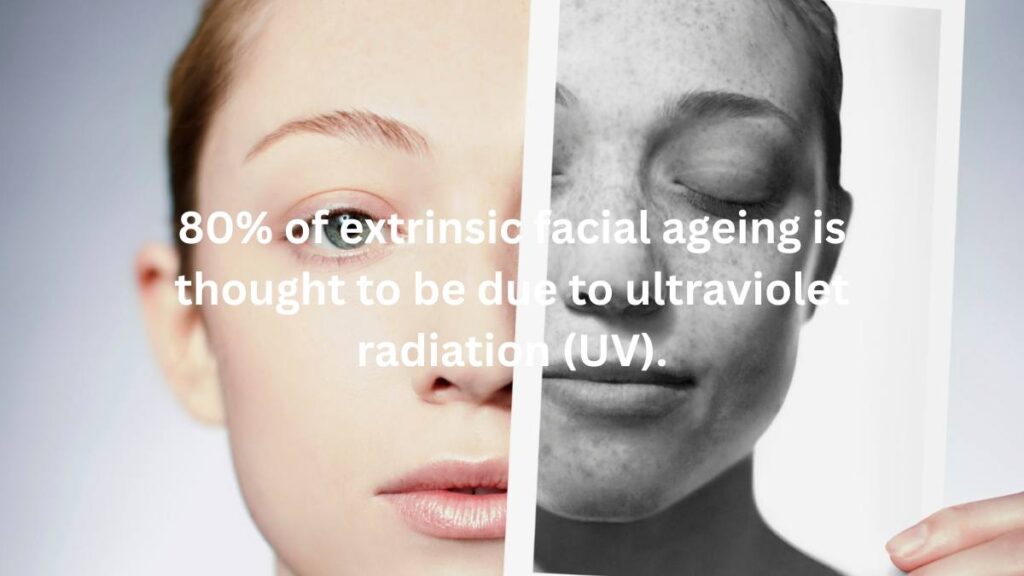
UV light, pollution, cigarette smoke and oxidative stress activate matrix metalloproteinases (MMPs), the enzymes that break down collagen faster than the body can replace it. This is referred to as extrinsic ageing and up to 80% of visible facial ageing is thought to be influenced by lifetime UV exposure alone.
4. Hormonal Changes (Perimenopause & Menopause)
Oestrogen plays a major role in collagen regulation. When levels fall in perimenopause and menopause, collagen content can drop by up to 30% in the first five years.
This helps explain why:
- The skin becomes thinner
- Wrinkling suddenly accelerates, and
- Healing is slower
This is a critical time when many women first become aware of visible skin ageing.
5. Daily Habits That Damage Collagen
Lifestyle choices can either protect collagen or destroy it faster. Some harmful lifestyle factors that can influence collagen production are detailed in the following table:
| Harmful Habit | Effect on Collagen |
| High sugar diet | Sugars form AGEs (Advanced Glycated End Products) which stiffen and damage collagen |
| Smoking | Toxins reduce blood flow and increase collagen breakdown |
| Chronic stress | Cortisol from chronic stress slows fibroblast activity |
| Poor sleep | Reduced cellular repair and antioxidant protection |
| Excess alcohol | Dehydration and oxidative stress |
The good news is that these harmful habits are modifiable risks that we can change to prevent further excess collagen breakdown and damage.
How Collagen Banking Works
Collagen banking is a proactive approach to skin ageing. The idea is simple:
boost collagen production before major signs of ageing appear, so the skin can better maintain its structure long-term.
Collagen doesn’t regenerate instantly, it can take 3–6 months for new fibres to form and mature. By stimulating fibroblasts early (typically from late 20s onwards), we help build a stronger collagen reserve that declines more slowly with time.
Who benefits most from collagen banking?
- People in their 30s and 40s noticing early laxity or dullness
- Individuals with high sun exposure or pollution exposure
- Women entering perimenopause, facing accelerated collagen loss
- Those wanting visible benefits now and healthy ageing later
What results are realistic?
Collagen banking is about long-term skin resilience, not a quick fix. It will not stop ageing or ‘freeze’ the skin and it does not replace healthy skin habits but it may help in the following ways:
- Smoother texture
- Improved firmness and elasticity
- Slower progression of fine lines
- Better skin treatment responses later in life

Evidence for Collagen Banking: What Actually Works
Here, I break down the strongest evidence and clinical strategies for preserving or increasing collagen, categorised by strength of support.
Strong / Well-Supported Interventions
- Broad-Spectrum Sunscreen
- Ultraviolet (UV) exposure is one of the biggest drivers of collagen breakdown via activation of enzymes called matrix metalloproteinases (MMPs).
- Daily broad-spectrum sunscreen remains foundational in any collagen-preserving plan.
- Retinoids
- Retinoids (e.g., tretinoin, retinol) stimulate fibroblast activity and collagen production. Numerous clinical trials support improvements in dermal thickness, skin elasticity, and fine lines with consistent use. Products like Medik8 and Revision Skincare are medical grade skincare that gently incorporate retinoids into their evening skincare range.
- This aligns with a preventive, evidence-based aesthetic medicine approach and can be incorporated into a “banking” mindset.
- Diet & Nutrition
- Studies show that when dietary intake is optimal, fibroblasts are better able to synthesise new collagen. If you would like to learn more about how to boost collagen naturally, check out my earlier blog on this topic.
- Collagen synthesis requires amino acids (e.g., glycine, proline) and co-factors such as vitamin C. Supporting your diet with protein-rich foods and adequate vitamin C helps maintain the substrate for collagen production.
- In‑Clinic Stimulatory Treatments
These are arguably the core of collagen banking in a clinical setting.- Microneedling: Controlled micro-injury stimulates neo-collagenesis (making new collagen) via fibroblast activation.
- Biostimulatory Injectables: Substances such as polynucleotides, calcium hydroxyapatite (as found in HArmonyCa), or PLLA (poly-l-lactic acid) are used to provoke a wound-healing response, increasing collagen deposition over time.
- Energy-Based Devices: Radiofrequency, fractional lasers, and other modalities can drive collagen remodelling by heating dermal structures and triggering repair processes.
These treatments are supported by robust clinical evidence for their ability to increase dermal collagen density and improve skin texture and laxity.
Where the Evidence Is Weaker or Conflicted
- Oral Collagen Supplements
- Meta-analyses (e.g., of 26 RCTs, 1,721 participants) have shown improvements in skin hydration and elasticity with hydrolysed collagen supplementation. (Pu et al, 2023)
- However, a more recent meta‑analysis of 23 RCTs (1,474 participants) raised critical caveats: when studies are stratified by funding source, trials not funded by pharmaceutical companies showed no significant benefit; similarly, high-quality trials did not consistently demonstrate meaningful improvements. (Myung et al, 2025)
- Critics argue the subgroup analysis in that meta‑analysis has methodological issues, and some industry bodies have pushed back, stating that funding does not necessarily undermine validity. (NutraIngredients.com)
- In summary, while there is some signal of benefit, the magnitude, clinical relevance, and long-term impact remain uncertain. More research is needed in this area.
- Topical Collagen Products
- Collagen molecules in creams or serums are generally too large to penetrate deeply into the dermis. Their benefit is more likely related to hydration than to true collagen synthesis. Leading experts caution that topical collagen does not rebuild dermal collagen in any meaningful way. (The Guardian)
- Long-Term Sustained Banking From Early Age
- While collagen decline begins in one’s mid-20s, there is limited longitudinal data demonstrating that early intervention (e.g., in your 20s) meaningfully alters structural skin ageing decades later.
- Genetic factors, hormonal status, lifestyle, and sun exposure may have more influence on your “starting collagen bank” than any one early treatment strategy.
Practical, Research‑Aligned Plan for Collagen Banking
Based on the evidence, here is a phased, realistic roadmap for someone who wants a medically grounded collagen‑banking strategy:
20s – early 30s
- Daily sunscreen (SPF)
- Introduce gentle retinoid if suitable under medical guidance
- Ensure protein-rich diet and sufficient vitamin C
- Lifestyle: good sleep, stress management, avoid smoking
- Consider a baseline skin assessment for future planning
30s – 40s
- Continue sunscreen, retinoids, nutrition
- Begin in-clinic stimulatory treatments (microneedling / biostimulators)
- Consider devices if indicated (fractional RF, etc.)
- Reassess skin structure regularly to tailor your plan
40s and beyond
- Maintain preventive home-care
- Combine stimulatory treatments with volumising if indicated
- Monitor hormonal changes (e.g., peri‑menopause)
- Reinforce lifestyle factors, including resistance exercise, protein intake, and antioxidant support
Incorporating this framework aligns with a preventative aesthetic medicine philosophy, where we do not rely solely on “fixing wrinkles” but on sustaining skin health and structure from the inside out.
Expert Take‑Home: My Clinical Perspective
Collagen banking is not a gimmick. As an aesthetics doctor, I view it as a strategic, pre-emptive approach grounded in biology. The interventions with the strongest evidence are preventive lifestyle measures (sun protection, nutrition, retinoids) combined with targeted in‑clinic treatments that stimulate new collagen production. Supplementing with marine collagen may offer a modest benefit, but it is not a substitute for a structured, multi-modal plan, especially given the mixed quality of the evidence at this point in time. I personally continue to supplement with marine collagen and look forward to seeing more research in this field. Ultimately, collagen banking should be individualised: based on your age, skin condition, risk factors, and goals.
How This Aligns with My Aesthetic Practice
My approach to looking and feeling well always begins from the inside out. Achieving the best version of ourselves requires a holistic, evidence-based strategy that supports both the skin and the systems that influence it.
If you’d like more personalised guidance, I offer skincare coaching that includes retinoid protocols, antioxidant nutrition, and tailored prevention plans using medical-grade skincare. I also incorporate the pillars of lifestyle medicine, optimising sleep, exercise, diet, and stress in order to ensure your results are long-lasting and supported at every level.
On my treatments page you can learn more about the injectable options that hydrate the skin and stimulate fibroblast activity, including polynucleotides, HArmonyCa, and Profhilo. And if you’re interested in learning about menopause skin changes and how to improve them, you can find my earlier evidence-based blog here.
FAQs About Collagen Banking
Q1. Can you really increase collagen as you get older?
Yes, while natural collagen production declines with age, certain lifestyle habits and clinically-supported treatments can help support and maintain collagen levels. This includes adequate protein intake, vitamin C, regular resistance training, good sleep, and sun protection. Some in-clinic treatments like micro needling, polynucleotides, and HArmonyCa can also stimulate fibroblast activity.
Q2. What lifestyle habits make the biggest difference to collagen?
The fundamentals: consistent sunscreen use, a diet rich in antioxidants, high-quality sleep, managing stress, and regular exercise. These have measurable effects on skin inflammation, oxidative stress, and overall collagen integrity.
Q3. Does skincare actually help with collagen?
Certain ingredients do. Retinoids, peptides, and antioxidants (such as vitamin C) have the strongest evidence for supporting collagen synthesis or reducing collagen breakdown. “Collagen creams” are less reliable because collagen molecules themselves cannot penetrate the skin.
Q4. Are collagen supplements worth taking?
The evidence is mixed but growing. Some studies show improvements in skin elasticity and hydration with hydrolysed collagen peptides. Results vary, and supplements should be considered an adjunct and not a replacement for nutrition and skincare.
Q5. Which in-clinic treatments help with collagen?
Different treatments support collagen in different ways. Some hydrate the skin and create a better environment for fibroblasts to work efficiently, while others directly stimulate new collagen formation. Examples include polynucleotides, bio-remodellers, certain energy-based devices, and microneedling (where clinically appropriate). Patients should always have a full medical consultation to determine suitability.
Q6. How long does it take to see results from collagen-supporting treatments?
Most collagen-stimulating processes are gradual. Improvements usually become noticeable over 6–12 weeks, with continued refinement for several months depending on the treatment and individual biology.
Q7. Is it too late to start supporting collagen if I’m in my 40s or 50s?
Not at all. While prevention is helpful at any age, the skin remains responsive throughout adulthood. Meaningful improvements can still be achieved with the right combination of lifestyle, skincare, and treatment choices.
References:
Lloyd, K. (2025) ‘Is it true that … taking collagen supplements slows signs of ageing?’, The Guardian, 2 June. Available at: https://www.theguardian.com/lifeandstyle/2025/jun/02/is-it-true-that-taking-collagen-supplements-slows-signs-of-ageing [Accessed on 26 November 2025].
Myung, S-K. & Park, Y. (2025) ‘Effects of collagen supplements on skin aging: a systematic review and meta-analysis of randomized controlled trials’, The American Journal of Medicine, 138(9), pp. 1264–1277. doi: 10.1016/j.amjmed.2025.04.034. Available at: https://pubmed.ncbi.nlm.nih.gov/40324552/ [Accessed on 25 November 2025]
Park, S. (2022) ‘Biochemical, structural and physical changes in ageing human skin, and their relationship’, Biogerontology, 23(3), pp. 275–288. doi: 10.1007/s10522-022-09959-w. Available at: https://pmc.ncbi.nlm.nih.gov/articles/PMC10316705/?utm [Accessed on 20 November 2025]
Pu, S-Y., Huang, Y-L., Pu, C-M., Kang, Y-N., Hoang, K.D., Chen, K-H. & Chen, C. (2023) ‘Effects of oral collagen for skin anti-aging: a systematic review and meta-analysis’, Nutrients, 15(9), p. 2080. doi: 10.3390/nu15092080. Available at: https://pubmed.ncbi.nlm.nih.gov/37432180/ [Accessed on 25 November 2025]
Stern, C. (2025) ‘Industry pushes back on meta-analysis concluding collagen supplements show no benefit for skin aging’, NutraIngredients, 26 August. Available at: https://www.nutraingredients.com/Article/2025/08/26/industry-reacts-to-meta-analysis-concluding-collagen-supplements-show-no-proven-benefit-for-skin-aging/ [Accessed on 26 November 2025].
Varani, J., Dame, M.K., Rittie, L., Fligiel, S.E.G., Kang, S., Fisher, G.J. & Voorhees, J.J. (2006) ‘Decreased collagen production in chronologically aged skin: roles of age-dependent alteration in fibroblast function and defective mechanical stimulation’, The American Journal of Pathology, 168(6), pp. 1861-1868. doi: 10.2353/ajpath.2006.051302. Available at: https://pubmed.ncbi.nlm.nih.gov/16723701/ [Accessed on 20 November 2025]