
Written by Dr Elaine O’Connor-Haq, MB BCh BAO, MPharm, L7Dip(Aes)
Medical Aesthetics Doctor and founder of Bespoke Medical Aesthetics, Colchester
“Nothing Works Anymore” – A Common Mid‑30s Skin Complaint
Many women reach their mid-30s and notice something unsettling: products that once supported glow, clarity, and resilience begin to feel unreliable. Breakouts linger, pigmentation proves more resistant, skin becomes reactive, or a persistent dullness emerges. In clinic, this is one of the most frequent concerns I encounter.
This experience is often attributed to skin “getting used to” products or the need for something newer or stronger. In reality, the explanation is more biological. Skin function changes with age, and these shifts influence how skin responds to topical interventions.

To understand why skincare stops working, we need to look at three interconnected processes:
- Skin barrier dysfunction
- Chronic low‑grade inflammation (inflammaging)
- Altered cellular signalling dynamics
1. The Skin Barrier: Your First Line of Defence (and Why It Weakens From Mid-30s)
Human skin is organised into three principal layers: the epidermis, dermis, and hypodermis. The epidermis, the outermost compartment, functions as the body’s primary barrier interface with the external environment. Its architecture varies by anatomical site; for example, thick skin such as the soles contains five distinct strata (layers).
Within the epidermis, barrier competence is largely governed by the stratum corneum. This highly specialised outer layer is composed of terminally differentiated keratinocytes (corneocytes – aka dead skin cells) embedded within a structured lipid matrix rich in ceramides, cholesterol, and free fatty acids. This organisation is frequently described using the “bricks and mortar” model, where corneocytes provide mechanical resilience and intercellular (between cells) lipids regulate permeability.
A competent stratum corneum performs several critical functions: minimising transepidermal water loss (TEWL), limiting the penetration of irritants, supporting antimicrobial defence, and enabling predictable interaction with topical actives. As Feingold (2009) demonstrates, stratum corneum lipids are fundamental to permeability regulation and barrier stability. With advancing age, gradual alterations in lipid synthesis, epidermal turnover, and cutaneous inflammatory signalling begin to emerge. These changes are not merely cosmetic; they have direct consequences for barrier efficiency, skin reactivity, and the consistency of response to skincare interventions, a dynamic that becomes increasingly relevant after our mid-thirties.
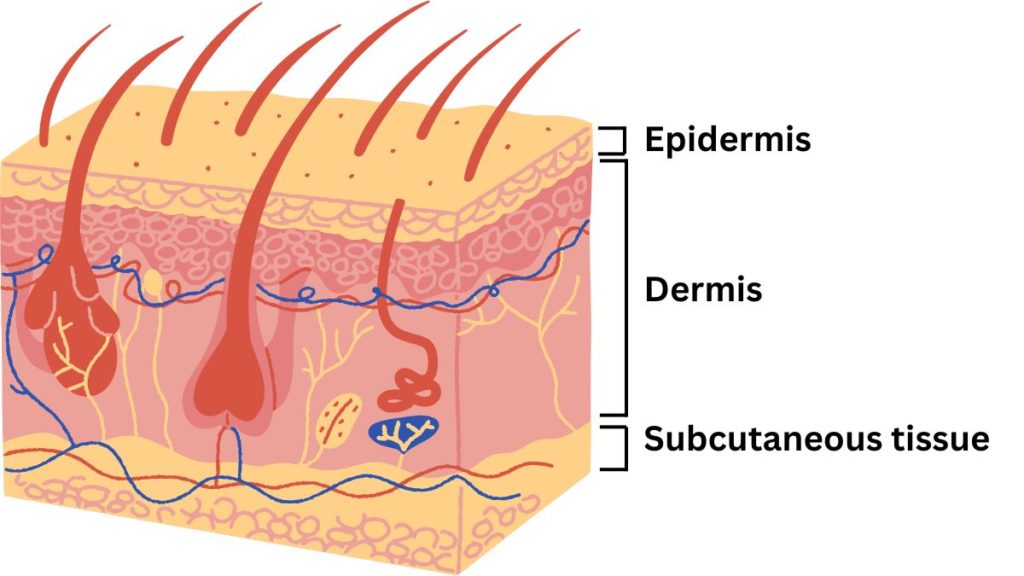
From the mid-thirties onward, several functionally relevant shifts occur:
- Reduced synthesis of ceramides, cholesterol, and free fatty acids
- Slower epidermal turnover dynamics
- Progressive decline in hormonal support, particularly oestrogen
Studies show that barrier lipid synthesis declines with age, leading to increased transepidermal water loss (TEWL) and greater skin sensitivity.
2. Inflammaging: The Silent Driver of Skin Behaviour Changes
Ageing skin is increasingly recognised as existing in a state of chronic, low-grade inflammation, a phenomenon widely referred to as inflammaging. Unlike acute inflammation, which is transient and protective, inflammaging reflects a persistent elevation of baseline inflammatory activity. Keratinocytes, fibroblasts, and resident immune cells exhibit altered signalling behaviour, producing sustained levels of pro-inflammatory mediators even in the absence of overt injury or infection (Pilkington et al., 2021). This background activity is shaped by cumulative ultraviolet exposure, oxidative stress, metabolic processes, hormonal changes, and intrinsic ageing mechanisms.
A central biological contributor to this process is cellular senescence. With advancing age, senescent cells accumulate within the skin microenvironment and adopt a characteristic secretory profile that reinforces inflammatory signalling and disrupts tissue homeostasis (Lee et al., 2021). Over time, this inflammatory background affects multiple aspects of skin function, including:
- Barrier repair efficiency
- Collagen homeostasis
- Pigment regulation
- Neural and vascular sensitivity
Clinically, this explains why skin in the mid-thirties and beyond often behaves less predictably. Signs may include heightened sensitivity, slower recovery after cosmetic procedures, persistent redness, exaggerated reactions to previously tolerated products, or fluctuations in conditions such as acne and pigmentation.

Importantly, inflammaging also affects how skin responds to topical interventions. Many active ingredients rely on tightly regulated cellular signalling to produce consistent results. When inflammatory pathways are chronically activated, these responses become less stable: products may feel irritating, yield diminished results, or provoke unexpected reactivity, not because the formulations are ineffective, but because the biological environment of the skin has changed.
In this context, managing skin successfully is less about increasing product intensity and more about modulating inflammatory load and supporting regulatory balance.
3. Altered Skin Signalling: Why Your Skincare May Stop Responding
Skin function relies on a delicate network of cellular signalling. Keratinocytes, fibroblasts, melanocytes, and resident immune cells communicate constantly via cytokines, growth factors, and other signalling molecules to regulate barrier repair, pigmentation, collagen synthesis, and immune responses. In young skin, these pathways are tightly coordinated, allowing predictable responses to environmental stress and topical treatments.
With advancing age, however, chronic low-grade inflammation (inflammaging) and cellular senescence disrupt this communication network. Cells become less responsive to signals that normally promote repair and regeneration. Fibroblasts, for example, reduce collagen synthesis even when growth factors are present (Zhang et al., 2023). Keratinocytes slow turnover, and melanocytes may over- or under-respond to UV and inflammatory cues. This desynchronisation of cellular communication contributes to the variability often observed in mid-30s and older skin.
The clinical consequences are clear: products that once delivered consistent results may become less effective, trigger irritation, or produce uneven responses. Simply increasing product frequency or layering multiple actives often does not resolve these issues, because the underlying signalling environment, rather than the product formulation, has changed.
Understanding altered signalling reframes how skin ageing should be managed. Rather than chasing stronger or more complex routines, the goal becomes supporting regulatory balance, reducing inflammatory load, and promoting cellular responsiveness through targeted, evidence-based interventions. By restoring coordination within these pathways, skin can respond more predictably to treatments and maintain resilience over time.
A More Rational Approach to Skin in Your Mid-30s and Beyond
Understanding these mechanisms reframes how skin should be supported with age. The objective shifts away from pursuing increasingly aggressive routines and toward restoring functional stability. For many individuals, this involves:
- Prioritising barrier integrity and lipid support
- Reducing unnecessary inflammatory triggers
- Using actives with greater strategic precision
- Recognising that skin tolerance and responsiveness evolve
Effective interventions are therefore less about novelty and more about biological compatibility. Subtle adjustments in formulation choice, dosing, and treatment timing frequently produce better outcomes than wholesale routine changes.
Reframing the Narrative of Skin Ageing
Skin ageing is often discussed purely in visual terms, yet the underlying processes are fundamentally biological. Alterations in lipid metabolism, inflammatory regulation, and cellular signalling precede many visible changes and largely determine how skin behaves over time.
When skincare appears to “stop working,” it is rarely a failure of products alone. More often, it reflects shifts in the skin’s regulatory environment, changes that are normal, expected, and manageable when approached with an understanding of physiology rather than trends.
Ageing skin does not require increasingly complex routines. It requires increasingly intelligent ones.
For those seeking a more structured, evidence-based approach to skin health and ageing, a personalised consultation can help clarify which mechanisms are most relevant to your skin and how best to support them over time.
You can learn more about my skin health consultations here.
References:
Feingold, K.R. (2009) ‘The outer frontier: the importance of lipid metabolism in the skin’, Journal of Lipid Research, 50(Suppl.), pp. S417–S422. doi:10.1194/jlr.R800039-JLR200.
Lee, Y.I., Choi, S., Roh, W.S., Lee, J.H. and Kim, T.-G. (2021) ‘Cellular senescence and inflammaging in the skin microenvironment’, International Journal of Molecular Sciences, 22(8), 3849. doi:10.3390/ijms22083849.
Pilkington, S.M., Bulfone-Paus, S., Griffiths, C.E.M. and Watson, R.E.B. (2021) ‘Inflammaging and the skin’, Journal of Investigative Dermatology, 141(4 Suppl.), pp. 1087–1095. doi:10.1016/j.jid.2020.11.006.
Zhang, J., Yu, H., Man, M.-Q. and Hu, L. (2023) ‘Aging in the dermis: Fibroblast senescence and its significance’, Aging Cell, 23(2), e14054. doi:10.1111/acel.14054.