
Written by Dr Elaine O’Connor-Haq, MB BCh BAO, MPharm, L7Dip(Aes) GMC-Registered Doctor | Former Pharmacist | Founder, Bespoke Medical Aesthetics, Colchester
If you’ve been researching skin treatments recently, you’ve likely come across both Profhilo and Profhilo Structura, and found that most comparisons stop at “one hydrates, the other lifts.” That distinction is accurate, but it doesn’t tell you much about why the two products behave differently, or how to know which one your skin actually needs.
Having worked in medical aesthetics since 2019 and with a background spanning pharmacy, medicine, and Level 7 postgraduate training in aesthetic medicine, I want to offer something more useful than a product comparison: a clinical framework for understanding what your face is doing as it ages, and how each of these treatments relates to that process.
What most patients don’t realise is that the right choice between Profhilo and Profhilo Structura is never about the products themselves. It’s about identifying which tissue layer is driving the changes you’re seeing, and selecting the intervention that addresses that layer appropriately.
Understanding What Changes Beneath the Skin as We Age
Facial ageing is not a single event happening at the surface. It is a multi-planar process, meaning changes occur simultaneously across several anatomical layers, at different rates and in different regions of the face.
The skin itself loses collagen and elastin progressively from our mid-twenties, at an estimated rate of around one per cent per year. Hyaluronic acid, the molecule that gives skin its capacity to retain water and resist mechanical stress, also declines naturally with age. The consequence is reduced elasticity, impaired hydration, and increasing textural change.
Beneath the skin, the subcutaneous fat compartments of the face undergo both atrophy and descent. These fat pads, which in youth sit in distinct, well-supported positions, gradually lose volume and structural integrity, producing the hollowing and flattening that characterises a more aged appearance. Deeper still, the underlying bone architecture is not static either: the facial skeleton remodels over time, reducing the structural scaffolding that supports the overlying soft tissue.
What this means clinically is that by the time a patient notices visible change, several layers have typically already been affected. A treatment that addresses only the dermis will not correct structural deflation in the fat compartment. Equally, a treatment designed for the subcutaneous layer will not improve the skin quality concerns sitting closer to the surface.
This distinction is the scientific foundation for understanding why Profhilo and Profhilo Structura, despite sharing a common base molecule, are not interchangeable.

What Is Profhilo – and What Is It Actually Doing in the Skin?
Profhilo is often described as a “skin booster,” but that term undersells the science behind it. It is more accurately classified as a bioremodeller – a product designed not to fill or volumise, but to trigger the skin’s own regenerative processes from within.
It contains one of the highest concentrations of hyaluronic acid available in any injectable skin treatment: 64mg per 2ml. What makes it clinically distinctive, however, is not the quantity of HA but the way it has been engineered.
The Pharmacology Behind Profhilo – Why Formulation Matters
Most injectable hyaluronic acid products are cross-linked, meaning the HA molecules are chemically bound together to resist rapid degradation and stay localised at the injection site. This is appropriate for volumising fillers, where staying power and structural presence are the goal.
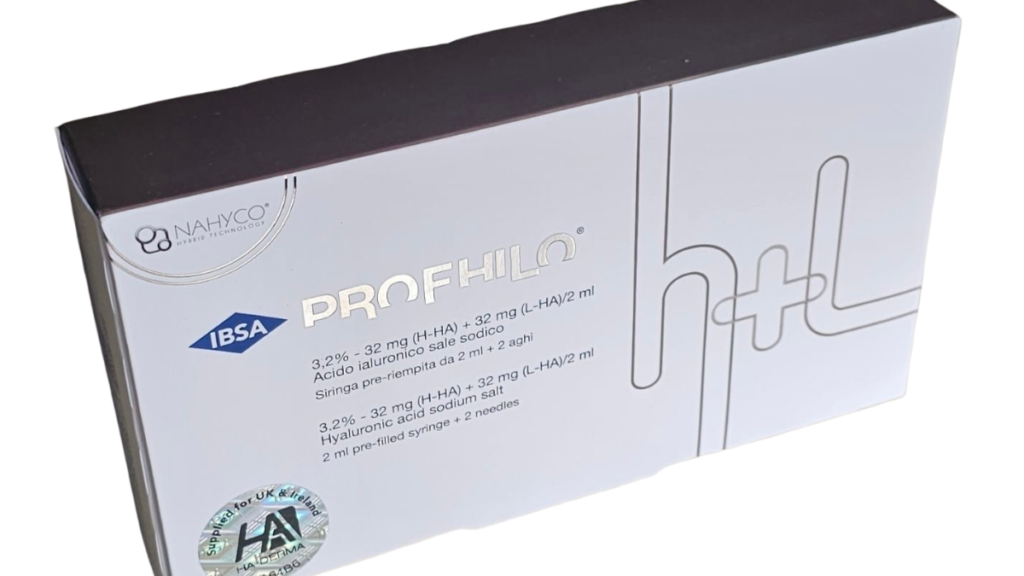
Profhilo uses a different approach entirely. Developed using NAHYCO technology, it combines high- and low-molecular-weight hyaluronic acid into a stable hybrid cooperative complex, without cross-linking. From a pharmacological standpoint, this is significant. The absence of cross-linking allows the product to spread through the dermis after injection rather than remaining fixed. As it disperses, it interacts with fibroblasts – the cells responsible for producing collagen and elastin – stimulating tissue remodelling rather than simply occupying space.
My background in pharmacy means I find this distinction genuinely important in clinical practice. Two products can share the same active molecule and behave in entirely different ways depending on their molecular architecture. Profhilo is a clear example of formulation driving function.
What Profhilo Can (and Cannot) Address
Profhilo performs best when the primary concern is skin quality: hydration, texture, fine lines, early laxity, and the general loss of luminosity that tends to develop from the mid-thirties onwards. It is well suited to patients who want to invest in their skin before structural changes become prominent, and it works across the face, neck, décolletage, and hands.
What it will not do is correct meaningful structural volume loss or lift a face where the deeper fat compartments have already begun to descend. That requires a different tool, and a different conversation.
What Is Profhilo Structura – and How Is It Different at a Cellular Level?
Profhilo Structura is produced by the same manufacturer as classic Profhilo and shares hyaluronic acid as its base molecule. Beyond that, the two products diverge considerably, in their formulation behaviour, their anatomical target, and the biological processes they initiate.
Where classic Profhilo is designed to integrate within the dermis, Profhilo Structura is engineered to work specifically within the superficial fat compartment – the subcutaneous adipose layer that sits beneath the skin and is responsible for facial shape, support, and three-dimensional contour. This is not a subtle distinction. It represents an entirely different tissue environment, with different cell populations, different receptor interactions, and different remodelling dynamics.
How Profhilo Structura Acts on Adipose Tissue
Once introduced into the superficial fat layer, Profhilo Structura interacts with adipocytes, the fat cells that populate this compartment, as well as the fibroblasts embedded within the surrounding extracellular matrix. It stimulates cellular renewal and reorganises the structural integrity of this deeper tissue, improving firmness and support from within rather than adding exogenous volume on top.
This is a meaningful pharmacological distinction. It is not filling the fat compartment. It is prompting the tissue that already exists there to behave more as it did at an earlier biological age, with greater resilience, improved organisation, and restored capacity to support the overlying skin.
What Profhilo Structura for Sagging Actually Achieves
The clinical outcome is a subtle but measurable improvement in facial definition, particularly in the mid-face, cheeks, pre-auricular region, and jawline. Patients do not look volumised or altered. They tend to look more structurally supported: a restoration of contour rather than a change in appearance.
For patients who have noticed their face beginning to flatten or descend, but who are not ready for, or not suited to volumising dermal fillers, Profhilo Structura occupies an important and genuinely useful clinical position.
Profhilo vs Profhilo Structura: A Clinical Comparison
The table below summarises the key clinical differences. It is intended as a reference point, not a decision tool. The right choice for your skin will always depend on a face-to-face assessment.
| Profhilo | Profhilo Structura | |
| Primary mechanism | Dermal skin bioremodelling | Subcutaneous (fat) tissue remodelling |
| Target tissue layer | Dermis (in skin) | Superficial fat compartment |
| Main clinical indication | Skin quality, hydration, texture | Structural support, facial contour |
| Treatment areas | Face, neck, décolletage, hands | Midface, cheeks, jawline, preauricular region |
| Aesthetic outcome | Improved radiance, elasticity, fine lines | Subtle lift, improved definition, restored contour |
| Standard protocol | 2 sessions, 4 weeks apart | 2 sessions, 4 weeks apart |
| Onset of visible results | 2–4 weeks post-course | 4–8 weeks post-course |
| Result duration | Approximately 6 months | Approximately 6–9 months |
| Ideal patient profile | Mid-30s onwards, skin quality concerns | Mid-40s onwards, visible laxity or deflation |
The most important takeaway from this comparison is that neither product is superior. They target different problems in different anatomical locations. Choosing between them is a clinical question, not a consumer one, and for a growing number of patients, the most appropriate answer is a carefully sequenced combination of both.
Who Is Each Treatment Best Suited For?
Classic Profhilo – The Skin Quality Investment
Profhilo tends to be the appropriate starting point for patients in their mid-thirties to mid-forties whose primary concerns are hydration, skin texture, early fine lines, and a general loss of luminosity. It is equally well suited to both men and women, and works well as a proactive skin longevity measure before structural changes become prominent.
Profhilo Structura – When Structural Support Is the Goal
Profhilo Structura becomes clinically relevant when visible deflation, midface flattening, or softening of the jawline is the primary concern, typically from the mid-forties onwards. It is particularly well suited to patients who want improved facial definition without the volumising effect of traditional dermal fillers.
A Note on Men
Male patients are often well suited to Profhilo Structura. Men typically seek structural refinement rather than volumisation, and the treatment’s ability to restore contour without adding bulk aligns naturally with that goal.
Can Profhilo and Profhilo Structura Be Combined, and If So, How?
This is one of the most common questions I encounter in consultation, and the answer is yes, with clinical rationale, not simply because two products exist.
The case for combining them is straightforward. Classic Profhilo addresses the dermis: skin quality, hydration, and early textural change. Profhilo Structura addresses the subcutaneous fat compartment: structural support, contour, and facial definition. These are complementary tissue layers, not competing treatment targets. Used together, they form part of a genuinely comprehensive approach to facial rejuvenation.
The Combined Protocol: Treating Skin Quality and Structure Together
In practice, I typically recommend completing a course of classic Profhilo first – two sessions, four weeks apart – before introducing Profhilo Structura. This allows the dermis to be in optimal condition before addressing the deeper structural layer, and gives a clearer picture of what the skin can achieve through bioremodelling alone before progressing further.
The two products should not be injected into the same tissue plane at the same session without careful clinical planning. Spacing and sequencing matter.
How This Fits Into a Longer-Term Skin Plan
Where bioremodelling treatments deliver the most consistent results is within a structured, longer-term approach to skin health, one that also considers skin quality treatments such as polynucleotides, appropriate skincare, and the lifestyle factors that directly influence how skin ages biologically. Injectable treatments work best when they are one component of that wider picture, not the entirety of it.
A consultation is always the appropriate starting point for establishing what that plan should look like for you individually.
What to Expect: Results, Timeline, and Realistic Outcomes
Results from both treatments are gradual and cumulative. Bioremodelling works by stimulating your tissue’s own regenerative processes – this takes time, and that is precisely what makes the outcomes look natural.
With classic Profhilo, most patients notice improved hydration and skin quality within 2-4 weeks of completing their initial course. With Profhilo Structura, structural improvements in contour and definition tend to become more apparent from 6-8 weeks post-course, as the deeper tissue remodelling process matures.
Both treatments involve minimal downtime. Mild swelling, tenderness, and occasional bruising at injection sites are the most commonly reported side effects, typically resolving within 24-72 hours. Profhilo Structura, given its deeper injection plane, can occasionally produce slightly more pronounced initial swelling in the treated area.
Individual results vary depending on skin quality, biological age, lifestyle, and tissue responsiveness. A thorough face-to-face consultation and assessment is always required before treatment.

Profhilo Structura in Colchester – What to Expect at Bespoke Medical Aesthetics
At Bespoke Medical Aesthetics, every treatment begins with an unhurried, assessment-led consultation. There are no fixed protocols and no predetermined treatment plans. Recommendations are made following a thorough facial assessment, full medical history review, and an honest conversation about what is realistic for your skin at this stage.
As a GMC-registered doctor, former pharmacist, and Level 7-trained aesthetic clinician, and as a member of the JCCP and associate of the British College of Aesthetic Medicine, clinical governance and patient safety underpin every decision made in this clinic.
If you are considering Profhilo, Profhilo Structura, or a combination of both, and you are based in Colchester or the wider Essex area, I would welcome the opportunity to assess your skin properly and discuss what a considered treatment plan might look like for you.
Book a consultation at Bespoke Medical Aesthetics
Frequently Asked Questions: Profhilo and Profhilo Structura in Colchester
What is the difference between Profhilo and Profhilo Structura?
Profhilo targets the dermis, improving skin quality, hydration, and elasticity. Profhilo Structura targets the deeper subcutaneous fat layer, restoring structural support and facial contour. They share the same base molecule but are pharmacologically distinct products designed for different tissue layers and different clinical concerns.
What is Profhilo Structura and how does it work?
Profhilo Structura is an injectable bioremodelling treatment that works within the superficial fat compartment of the face. Rather than adding volume, it stimulates adipocytes and fibroblasts to reorganise and firm the surrounding tissue, producing a subtle improvement in facial definition and support.
Is Profhilo Structura effective for sagging skin?
It is well suited to patients experiencing early to moderate facial laxity – particularly midface flattening, cheek deflation, and softening of the jawline. It is not a replacement for significant volumetric correction, which may be better addressed through other means. Suitability is always determined at consultation.
How is Profhilo Structura different from dermal fillers?
Dermal fillers add volume directly to a specific area, reshaping or augmenting facial features. Profhilo Structura does not add volume – it prompts the existing tissue to remodel and firm from within. The outcome is structural support rather than volumisation, which suits patients seeking refinement rather than enhancement.
Can Profhilo and Profhilo Structura be combined?
Yes, and for many patients in their late forties and fifties, a sequenced combination of both is the most clinically appropriate approach. Classic Profhilo addresses skin quality at the dermal level; Structura addresses structural support at the subcutaneous level. The two treatments are complementary rather than redundant.
How many sessions of Profhilo Structura are needed?
The standard protocol is two sessions spaced four weeks apart, followed by maintenance treatment approximately every six to nine months. Individual requirements vary and will be discussed at your consultation.
Is Profhilo Structura suitable for men?
Yes. Men are increasingly well represented amongst patients choosing Profhilo Structura. The treatment’s ability to restore facial contour and definition without volumising makes it particularly well aligned with the aesthetic goals many male patients describe.
How long do results from Profhilo Structura last?
Results typically last between six and nine months, though this varies depending on individual factors including biological age, skin condition, lifestyle, and how the tissue responds to treatment. A consistent maintenance plan supports longer-term outcomes.
What is the downtime after Profhilo Structura?
Most patients return to normal daily activities immediately. Mild swelling or tenderness at the injection sites is common and generally resolves within 24 to 72 hours. Strenuous exercise, alcohol, and heat exposure are best avoided for the first 24 hours following treatment.
Where can I get Profhilo Structura in Colchester?
Profhilo Structura is available at Bespoke Medical Aesthetics, a doctor-led clinic based in Colchester, Essex. Treatments are performed by Dr Elaine O’Connor-Haq, a GMC-registered doctor with postgraduate training in both pharmacy and aesthetic medicine. To arrange a consultation, please visit the contact page or call the clinic directly.
Choosing the Right Treatment
Profhilo and Profhilo Structura are both well-evidenced, clinically useful treatments. The distinction between them is not a matter of one being better than the other – it is a matter of understanding which tissue layer is driving the changes you are seeing, and selecting the intervention that addresses that layer appropriately.
If you are considering either treatment and are based in Colchester or the wider Essex area, the most valuable first step is a thorough consultation with a qualified medical professional who can assess your skin objectively and guide you accordingly.
Book a consultation at Bespoke Medical Aesthetics
References
British College of Aesthetic Medicine (2024) About BCAM – professional standards in aesthetic practice. Available at: https://bcam.ac.uk
Calvo, I. and Blake, E. (2013) ‘Hyaluronic acid and its use as a rejuvenation technique’, Dermatology Research and Practice, 2013, pp.1–7. Available at: https://pubmed.ncbi.nlm.nih.gov/15745228/
IBSA Derma (2023) Profhilo Structura – clinical evidence and product information. Available at: https://ibsaderma.com
Joint Council of Cosmetic Practitioners (2024) JCCP practitioner standards and register. Available at: https://jccp.org.uk
NHS (2024) Cosmetic procedures — choosing who will carry out your procedure. Available at: https://www.nhs.uk/conditions/cosmetic-procedures/
Sparavigna, A., Tenconi, B. and De Ponti, I. (2015) ‘Antiaging, photoprotective, and brightening activity in biorevitalization: a new solution for aging skin’, Clinical, Cosmetic and Investigational Dermatology, 8, pp. 57–65. doi:10.2147/CCID.S77742. Available at: https://pmc.ncbi.nlm.nih.gov/articles/PMC4330006/
Urdiales-Gálvez, F., Delgado, N.E., Figueiredo, V., Lajo-Plaza, J.V., Mira, M., Moreno, A., Ortiz-Martí, F., Del Rio-Reyes, R., Romero-Álvarez, N., Ruiz-Del Cueto, M., Stamatakis, P. and Rebenaque, C.V. (2018) ‘Treatment of soft tissue filler complications: expert consensus recommendations’, Aesthetic Plastic Surgery, 42(2), pp.498–510. Available at: https://pubmed.ncbi.nlm.nih.gov/29305643/